Walk into a konbini in Shibuya or a warehouse in Chiba and you’ll often hear Vietnamese, Tagalog and Bahasa Indonesia alongside Japanese. The numbers explain why. Japan’s foreign resident population passed 4.12 million at the end of 2025, up 9.5% in a single year, the fourth record high in a row. Vietnamese residents now number 681,100. Filipino residents reached 356,579 at the end of 2025, the fourth-largest community in the country. Indonesia’s community is growing faster than almost anyone else’s, up roughly a third year on year.
This is a working, spending population, not just a wave of tourists passing through. It’s also the reason Japan’s foreign labour force hit a record 2.57 million workers in 2025. Every one of those workers is also a consumers, and a growing share of that spending happens online rather than at a till.
Southeast Asia’s Online Habits Have Outpaced Japan’s Checkout
Southeast Asian residents bring some of the most mobile-first payment habits in the world with them. Sending money home, paying bills, topping up a family member’s account, ordering from a home-market marketplace: all of it happens through an e-wallet, and each home market has its own leading methods.
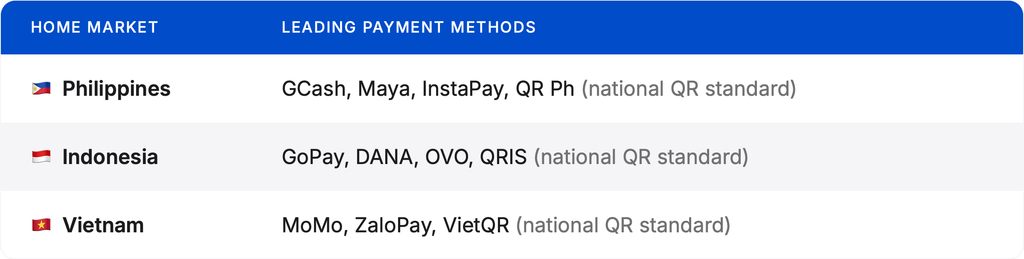
Source: Fintech News Singapore, 2026
These are the methods Southeast Asian residents already trust, but that fluency hasn’t yet carried over to Japanese online checkouts. For example, GCash, the wallet most Filipinos already use at home, is set up for remittances out of Japan. However, most Japanese online stores still can’t accept GCash as a payment method, even though the habit and the preference is already there.
The same gap shows up across the Filipino, Vietnamese and Indonesian communities in Japan as a whole. Hundreds of thousands of residents have real spending intent, payment methods they already trust, but most Japanese online checkouts still price in yen only and accept just a Japan-issued card or bank transfer. Those are lost sales, repeated on a massive scale.
Adding a payment method in a new market has traditionally been slow and complex
Offering a payment method that isn’t yet available in Japan has traditionally meant doing the groundwork market by market. Merchants have typically needed to work with a separate local payment provider in each country, integrating each one individually. Repeated across several markets, the process is time-consuming and operationally complex.
In Japan, that complexity stands between merchants and over 4 million foreign residents, a growing share of them Vietnamese, Filipino and Indonesian, whose payment habits are already formed in the wallets and currencies they use at home.
That’s exactly the gap Hello Clever closes in Japan.
Local payment methods and pricing that travel with the customer
Hello Clever supports 54+ local payment methods across across 25+ currencies, through one integration. There is no need for a separate build for each country. A merchant doesn’t need a Singapore entity to offer a customer from Southeast Asia the payment method they already reach for at home.
To learn more about accepting local payment methods at checkout in Japan, download our eBook.
For a Japanese online merchant with a meaningful share of Southeast Asian customers, that means the checkout can offer a payment method they already trust, instead of asking them to find a Japan-issued card first. Customers complete more purchases when they can pay in a method and currency they already trust.
Japan’s foreign population continues to boom, and isn’t showing signs of slowing down. Hello Clever gives merchants a way to meet that growth at checkout, in the payment methods and currencies these customers already use.
Leave a Reply