Platforms and marketplaces are on track to drive 53% of all ecommerce growth by 2030 (Cymbio, 2025). As more commerce shifts from individual merchants to platforms, the payment infrastructure sitting underneath those platforms is becoming one of the more consequential decisions they make. For an individual platform, it becomes a growth lever if the infrastructure is right, and a ceiling if it isn’t.
What gets less attention is what sits behind that growth: the payment infrastructure a platform runs on. Most platforms treat it as plumbing, something to get working and then forget about, the same way they’d treat shipping or tax calculation. It’s rarely a deliberate choice. It’s usually just whatever came bundled with the first provider they signed up with.
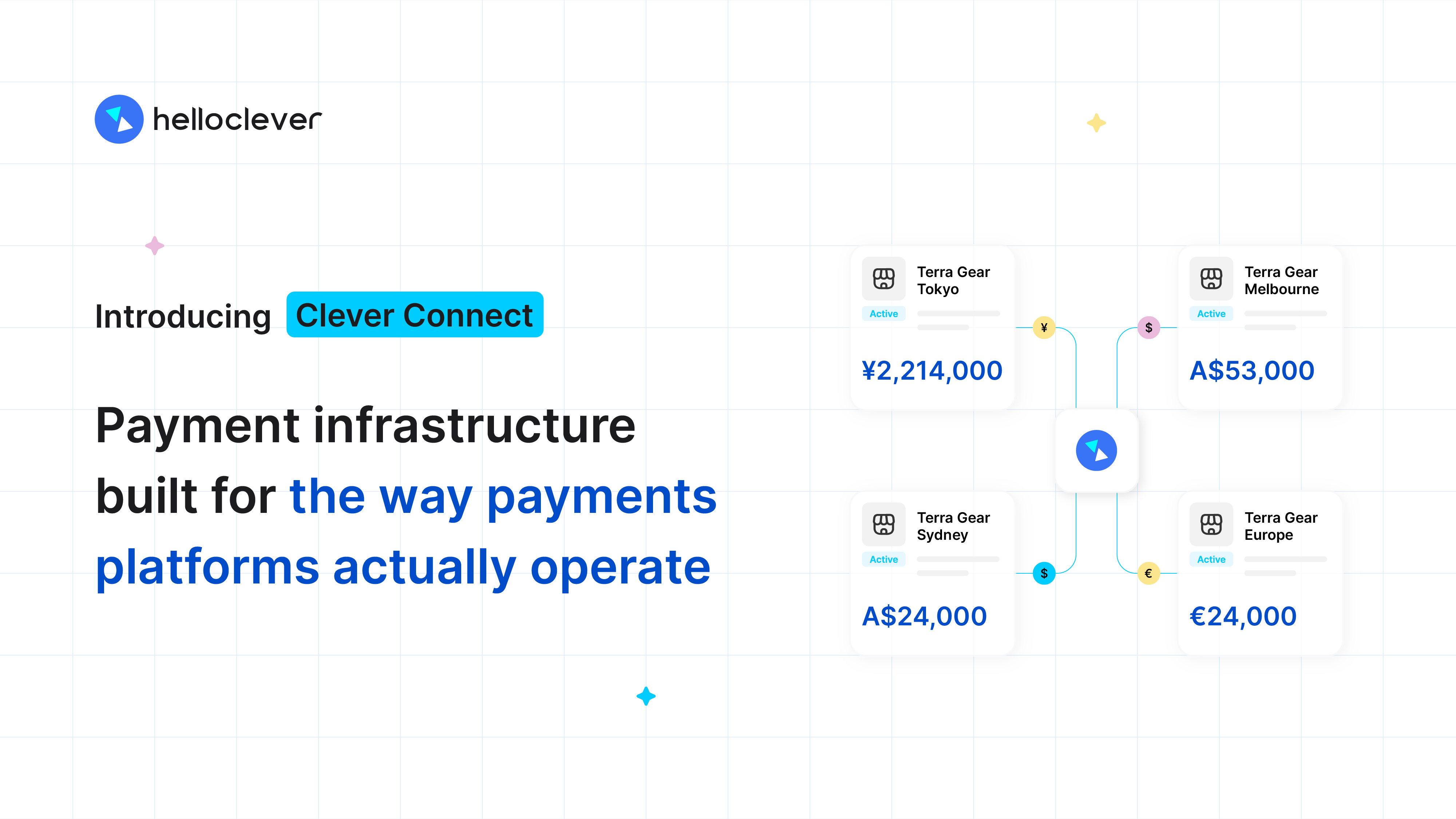
The platforms that build in control over onboarding, settlement, and fees, rather than defaulting to whatever a provider hands them, are the ones set up to capture that growth instead of just enabling it. Clever Connect is Hello Clever’s answer for platforms making that call.
Payments plumbing breaks in a predictable order for platforms
If you run a platform with more than a handful of merchants, some version of this will be familiar.
✅ Money doesn’t land where or when you need it. Everything arrives in one account, so someone has to work out which merchant it belongs to, what they’re owed, and what the platform keeps, before any of it can move again. That’s a spreadsheet at five merchants and a full-time role at fifty, and every new currency you add makes the sorting worse, not better. Cross a border and it compounds: without a banking presence in the market you’re settling in, money sits in transit, converting and moving through an offshore account, while a merchant waits on a payout that isn’t actually available yet.
✅ Your merchants meet someone else before they meet you. Onboarding usually means handing a merchant off to a third party for verification, on that provider’s timeline, in that provider’s experience. You brought them to your platform, but somebody else is running their first real interaction with it, and you don’t get to set the pace or fix it if it’s clunky.
✅ You’re generating the volume, but you’re not the one earning from it. Standard payment infrastructure charges a processing fee on every transaction, and that fee goes to the provider, not the platform whose merchants and customers created the volume in the first place.
None of this shows up on day one. It shows up as the merchant count climbs, and by the time it’s painful, the infrastructure decision behind it was made a long time ago, usually without much of a decision at all.
What being in control of platform payments actually looks like
The approach changes when the infrastructure is built for platforms, not adapted to them.
Every merchant’s money is separate from the moment a payment lands. Dedicated payment accounts mean reduced manual reconciliation. Each merchant sees exactly what’s theirs without the platform doing the sorting. In Australia (with Japan and the United States coming soon), treasury accounts give platforms a domestic banking presence in each market with settled funds held locally in local currency, available to use as needed on the platform’s terms.
Merchants submit their own verification details directly inside the platform’s own flow, instead of being redirected to a separate page. The platform sets the pace and shapes the experience from the first interaction, while Hello Clever’s risk assessment runs quietly behind the scenes to make sure every merchant is properly verified.
Platforms can also set and collect their own fees on payment activity, turning the volume they generate into direct revenue.
The case for treating payments infrastructure as a strategic decision, not just an operational one
Payment infrastructure gets filed under operations because it’s treated as something to get working, not something to think about strategically. That’s the assumption worth questioning.
Every merchant onboarded, every dollar settled, and every fee collected is a moment where control sits either with the platform or with whoever’s running the infrastructure underneath it. For most platforms, that’s already been decided by default, in favour of whichever provider they signed up with first.
The platforms that get this right stay in control of the merchant relationship, the settlement experience, and the revenue their own growth generates.
For platforms ready for what’s next
The infrastructure decision a platform makes early shapes what scale looks like. Getting the structure right at the start means growth adds capability, not complexity.
Clever Connect is built for platforms ready to own their payment operations, not work around them.
The next stage of growth deserves infrastructure that was built for it.
Want to get started? Talk to the team https://helloclever.co/get-in-touch
Leave a Reply