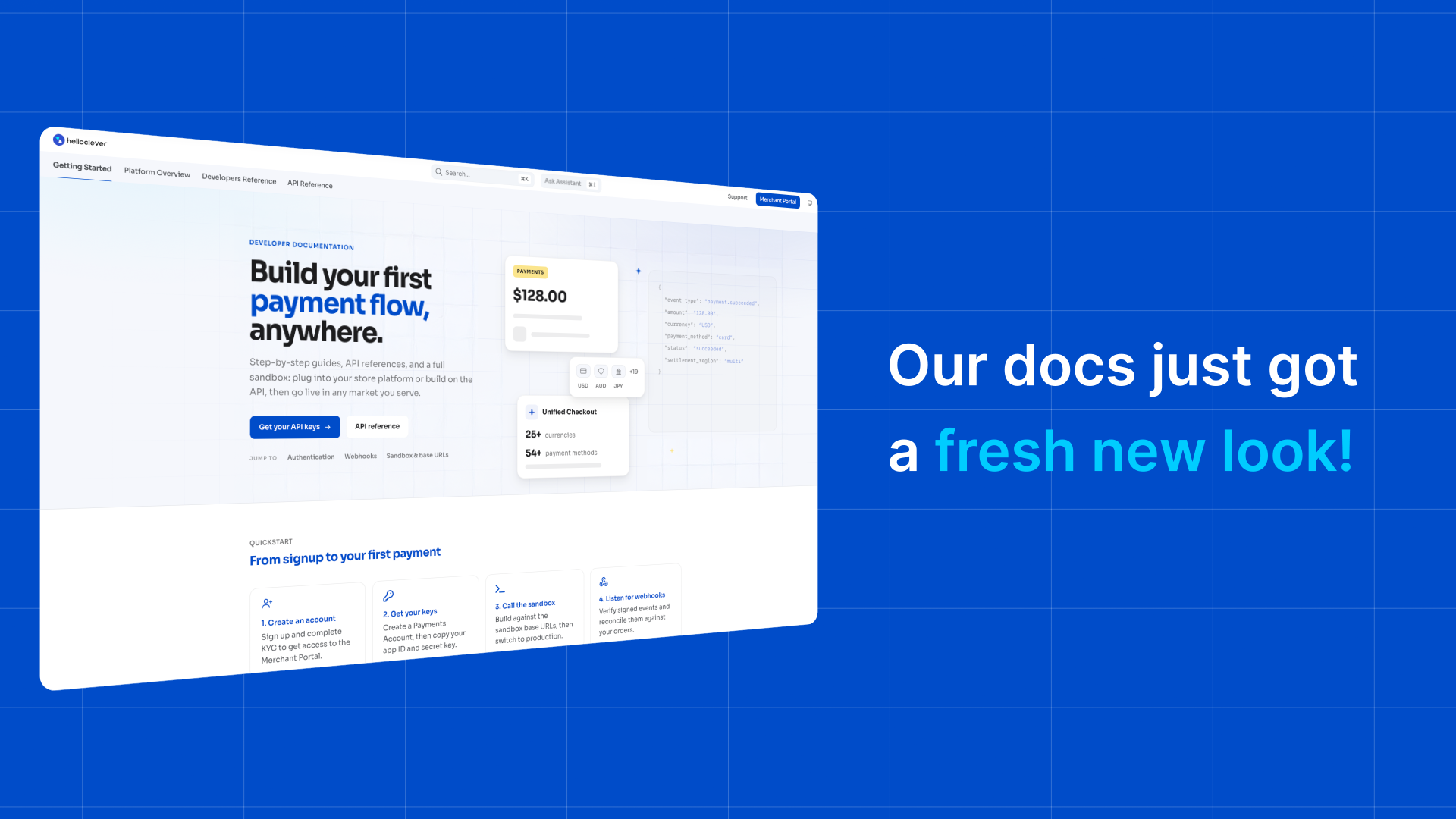
We’ve rebuilt our documentation from the ground up, and it’s built to get you moving faster, whether you’re setting up your first merchant account, expanding into a new market, or building a custom integration.
Here’s what that means
✅ A visual refresh across the whole site, cleaner navigation and a clearer layout, so finding anything takes fewer clicks, on any device
✅ For merchants: clear, plain-language guidance that doesn’t require touching code, so you can get set up without pulling in a developer
✅ For developers: every part of the platform (payments, cards, multi-currency, cashback) has its own clear API reference, all authenticated the same consistent way, so your team isn’t relearning how requests work every time they touch a different one
✅Concepts that go beyond the how-to guides, explaining how payments and the platform actually work
✅ A built-in AI search bar, so you get a direct answer without digging through pages to find it yourself
A clearer way to find your way around
The whole site has been restructured to be easier to navigate, whether you’re a merchant managing your business day to day or a developer building an integration. Related content sits together, menus are simple, and getting from a general question to a specific answer takes just a few steps, so you land exactly on the answer you’re looking for.
For developers: everything you need to start building right away
The new docs site gets you from account creation to your first webhook in four steps, with sandbox examples along the way.
Developers Reference is where you go to figure out how to build something: integration guides, use cases like setting up recurring billing, and security explanations. API Reference is
where you go once you already know what you’re building and just need the exact parameter or endpoint, without wading through explanatory paragraphs mid-build.
It’s the same story once you’re inside the API Reference itself: five APIs, one header pair, with a single documented exception, so building your second integration doesn’t mean relearning anything. If you’ve set up a one-off payment flow and later need to add recurring billing on a PayTo agreement, or start accepting multi-currency payins and payouts, you’re extending something you already understand.
Before anything touches production, sandbox tools let you simulate treasury deposits and transfer outcomes, so the edge cases, such as a failed transfer, get tested against your own integration before a real customer ever hits them.
For merchants: docs that put you in control of your business
Platform Overview walks you through setting up and running your business without touching a line of code. It covers creating your merchant account and connecting your store, and once you’re live, it keeps going: how your money actually moves, the difference between an Aggregated Balance and a Dedicated Balance, how treasury accounts work, and what happens between a customer paying and the funds landing in your account.
The docs also cover the day-to-day of actually running the business: adding team members, resolving a dispute with confidence, and launching an Instant Cashback campaign backed by real strategy rather than guesswork. Clever AI is there for the same reason: actionable insights on your store and payment data, and a cash-flow forecaster that turns that guesswork into something you can plan around.
There’s also the side of the business you only think about when it matters: how we handle SOC 2, KYC and transaction monitoring, what happens to your data, and how fraud monitoring, card security and API security work behind the scenes.
No-code setup guides cover connecting your store to platforms like Shopify and WooCommerce, so you can go from account creation to your first payment yourself.
Understand the concepts behind every step
The docs go beyond step-by-step instructions into how things actually work underneath. Payment concepts cover the fundamentals: the real difference between real-time account-to-account payments and card payments, for instance. A payment concept in Australia doesn’t work the same way as one in Japan or the US, so everything is organised market by market.
Clever Concepts covers the platform’s own model: balance models, treasury accounts and how a transfer actually flows from end to end, so the operational side of the platform makes as much sense as the payment rails underneath it.
That understanding is designed to help you make better decisions with the platform, like knowing when to move settled funds with confidence, or choosing the right payment rail for a new market.
Finding an answer has never been easier
The docs now include a new search bar built with AI search capabilities. Search in your own words, however you’d naturally describe what you’re after, and it matches you to the right result.
Explore the new docs site
The new documentation site is designed to get you to your answer faster, whatever you’re trying to build with Hello Clever. Explore it at [docs.helloclever.co].
Leave a Reply