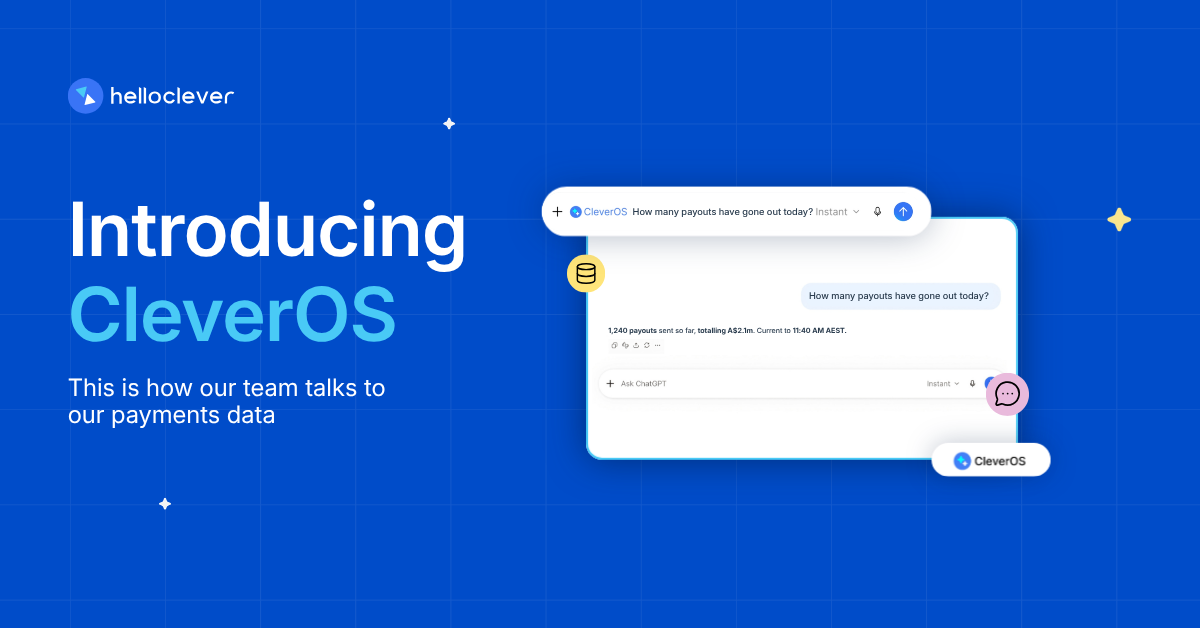
We built an internal AI system called CleverOS.
Our team asks it a question about our payments data, in plain English, straight from Claude or ChatGPT. Approval rates, deposit volumes, payout SLAs, supplier health, dispute flags. It answers off a data layer we’ve audited against the source system, and it doesn’t stop at handing back a single number. It separates declines from abandoned checkouts. It flags when a sample’s too small to draw a conclusion from. It catches a payout delay and names the supplier behind it before anyone has to dig.
Nobody’s blocked waiting on a number anymore. That alone changes how fast a decision can move.
Why we built CleverOS
Most AI tools are great at answering a question, once someone already knows which dashboard to open and which filter to apply first. That’s an extra step our team shouldn’t have to take for something as simple as a number they need right now. Dashboards are built for the questions people already know they’ll ask again and again. We wanted something for the question nobody thought to build a report for. So we built something that sits across our payments data and answers directly, in plain English, without anyone writing a query or waiting on whoever owns the report.
How it works
CleverOS connects straight into Claude or ChatGPT. Tag it, ask a question, and it gets to work, pulling the answer from a data layer we’ve checked against the source system — a Postgres-backed warehouse we query directly, so there’s no stale export sitting between the question and the answer.
A few things our team are already doing with CleverOS:
✅ Building weekly performance slides automatically, ready before anyone’s asked for them
✅ Compiling approval stats on a running schedule instead of pulling them manually
✅ Watching remaining merchant capacity hour by hour, without opening a single report
People are running it daily, weekly, even hourly, depending on what they’re watching and how fast it changes.
Built on MCP
CleverOS runs on the Model Context Protocol (MCP), the open standard for connecting AI to real data and tools, co-developed by Anthropic. It’s why the same system works inside both Claude and ChatGPT: we built the data layer once, and MCP is what lets either one reach it. We didn’t want our own team locked into a single AI tool just to get the benefit, and building on an open standard means we’re not starting over the next time a new one shows up.
Skills: Freeing up the team for what matters most
Alongside CleverOS, we’ve also been building Skills: a standardised way to get consistent output on the tasks a team does over and over. CleverOS reaches the data. Skills make sure a repeatable task comes out the same, consistent way every time.
Put the two together and a lot of the grind drops out of a normal week for our team. That’s less time spent on the repeatable parts of a job, and more time spent on the tasks that matter most.
This is just the start
We built CleverOS because we believe the way our own team gets answers from data should look like the way we want merchants getting answers from theirs: direct, in plain English, without a wait.
AI already reads every transaction moving through Hello Clever in real time, working out what a merchant needs to know before they ask. CleverOS turns that same capability inward, onto our own team’s day-to-day decisions, and what we learn from running it on ourselves is already shaping what we build next.
Leave a Reply